



1979-93 Mustang Parts
Follow along as LMR walks you through the differences between to 1986-2004 Mustang 8.8" rear ends.
If you are scouring your local junkyard or purchasing a rear end from an online marketplace, you need to ensure what you are purchasing is exactly what you need. Since the Ford 8.8” was used in a variety of vehicles including the Mustang, Explorer, and Ranger, you will need to know what to look for to ensure a perfect fit for your Mustang. Today, we are going to look at the differences between the 1986-2014 Mustang 8.8” rear ends and how you can identify which rear end you are looking at.
The 8.8” straight-axle rear end was used in Ford Mustangs from 1986-2014. Throughout the 1986-2010 years, a 7.5” rear end was used in 4-cylinder and V6 models where an 8.8” rear end was not needed. In 2011, the V6 Mustangs were equipped with an 8.8” rear end. In 2015, Ford switched over to a Super 8.8” IRS, or Independent Rear Suspension, giving the S550 more suspension performance on and off the road course.

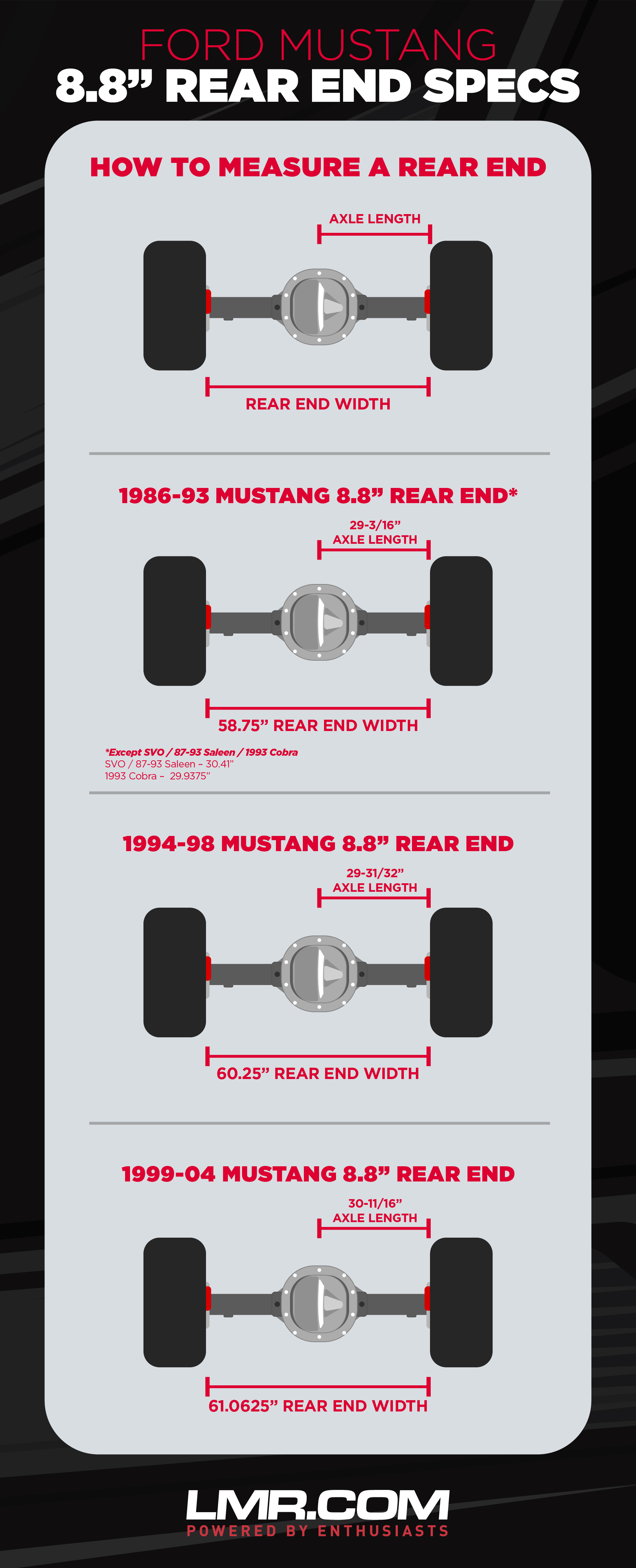
1986-1998 - Housings Are The Same/ 86-93 Has Drum Brakes (Minus SVO/Cobra)
The SVO, 87-93 Saleen and Lincoln Mark VII are 30.41"
The 93 Cobra Axles Are 3/4" Longer Than Stock Fox - 29.9375"
Axle Length - 29 3/16"
Rear End Width - 58.75”
1994-1998 - Disc Brakes & Axles Are ¾” longer making the width 1.5” wider than 86-93
Axle Length - 29 31/32"
Rear End Width - 60.25”
1999-2004 - Disc Brakes & Axles Are 1.5” longer making the width 3” wider than 86-93
Axle Length - 30 11/16"
Rear End Width - 61.0625"
Whether you are swapping in an upgraded rear end, needing to replace yours, or simply want to find out what’s under your car, there are a few ways to identify an 8.8” rear end, depending on when the rear end was made.
The cover shape difference between 7.5” and 8.8” is the quickest way to identify an 8.8” from a 7.5” rear end.
The 8.8” rear end is flat on the top and the bottom as well as the left and right. It has a square design with four rounded corners and ten bolts. When measuring from the top left bolt to the bottom right bolt, the 8.8” rear end will measure 11” from bolt to bolt.
The 7.5” rear end is also flat on top and bottom. However, the visual difference comes in where it is rounded on the right and left and, like the 8.8” rear, has ten bolts. When measuring from the top left bolt to the bottom right bolt, the 7.5” rear end will measure at 10” from bolt to bolt.
One quick look at an 8.8” rear end can answer your questions pretty quickly. If the rear end is equipped with drum brakes and came out of a Mustang, it will most likely be from 1986-1993. A few exceptions would be a rear end from an SVO or 93 Cobra which both featured rear disc brakes.


If you are lucky, your Mustang’s rear end may still have a metal tag or visible ID sticker. If you have a metal tag still, you can use our Mustang Rear End Guide to learn how to read this tag to identify your rear end.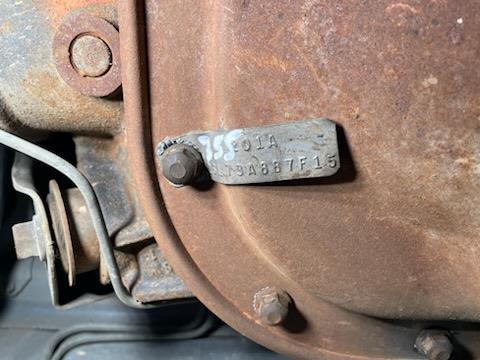
If you cannot identify the rear end using the above methods, you can measure the rear end or axles to determine which rear end you have. Use the specs above to cross-reference the measurements of the axle width or rear end width.
When purchasing a used 8.8” rear end, it is always a good idea to figure out what gears are installed. There are a couple of ways you can do this.
If you are sure that the factory gears are still in place, you can reference our Mustang factory gear ratio article to determine what gears are in your rear end.
If you want to double-check the gear ratios, you can follow our step-by-step guide on how to determine a Mustang’s rear axle ratio.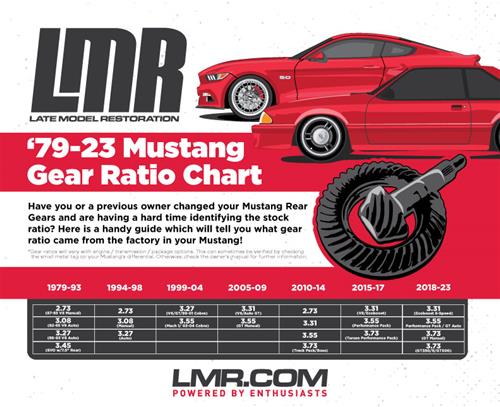
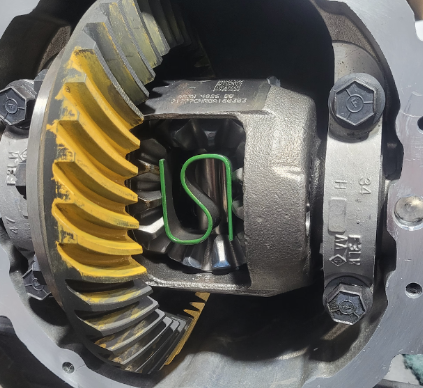
Unless you have a metal tag stating that your 8.8 is equipped with a limited-slip, the easiest way to check is to pop off the differential cover and look for the iconic “S” clip. This “S” clip is used to keep preload on the limited slip clutches. All 8.8” rear ends in 1986-2014 Mustangs came equipped with limited slip differentials, known as Traction-Lock.
It is no secret that the Ford Mustang's 8.8” rear end is one of the most popular domestic drivetrain components in automotive history. Spanning a 28-year production period, it is safe to say that Ford produced a couple of million 8.8” rear ends.
With over 1 million Fox Body Mustangs built from 1986-1993, there are plenty of 8.8” rear ends floating around junkyards, scrap piles, and cars being parted out. Since you can go to just about any junkyard and pull out a rear end for around $100, makes these components are cheap and easy to find, even if they need to be rebuilt. They are also great for sourcing rear axles and other components you may need for your build.
While this will most likely be a topic that gets debated until the end of time, for what it's worth, the 8.8” rear end was strong for what it was used for. Now, of course, if you started adding some serious power and rev dumping on a sticky track, your 8.8 might spill its guts, but for the average weekend warrior, the factory 28 spline axles and differential were plenty tough.
For drag racing and hot rod enthusiasts, the Ford Mustang 8.8” was seen as an easy-to-upgrade rear end with plenty of aftermarket support. Let’s take a closer look at some of the most popular upgrades for the Ford 8.8” rear end.
31 Spline Axles - In factory 8.8” solid axle rear ends, 28 spline axles were used in 1986-2004 Mustangs (excluding 03-04 Cobra w/ IRS). 31 spline axles are the perfect upgrade to strengthen the 8.8”. These axles are not only equipped with more splines, they are also bigger in diameter. To learn more about the differences, check out our 28 spline vs 31 spline axle article. All 2005-2014 8.8 rear are 31 spline. Including 07-14 gt500. 2001 Cobra also had 31 spline, but the cv shaft is not as beefy as the 03-04 cobra ones.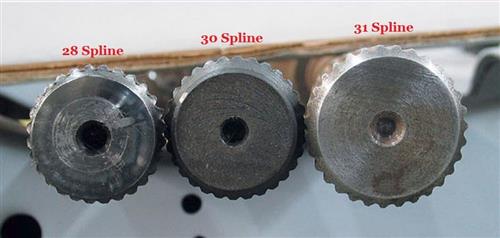
C Clip Eliminators - The axles in your drivetrain are held in place by a small c-clip from the factory. While this is fine for daily driving, they become a weak point when launching your car at the drag strip. C-clip eliminators remove this internal clip and replace it with an externally pressed-on bearing that holds the axle shaft into place. These are not recommended for street use or road racing as they have a tendency to leak under cornering.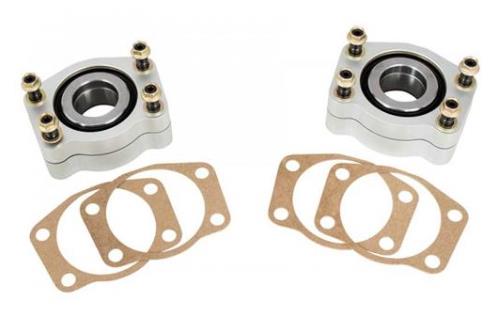
Upgraded Ring & Pinions - For daily driving, the Mustang’s factory gear ratios allow for comfortable driving and efficient fuel mileage. A popular upgrade for Mustang owners looking to increase acceleration is to upgrade the ring and pinion. Most choose to go with a 3.73 or 4.10 gear set, but you can choose to go higher or lower, depending on the type of driving you will be doing or what type of power adder you’ll be using.
Welded Axle Tubes - A common modification for many Mustang owners is welding the axle tubes. The axle tubes on an 8.8” rear end are held in place by a couple of plug welds and are known to rotate inside the housing when launching at the track. Welding these tubes all the way around where they enter the housing will drastically improve structural rigidity..There are also several available options in the aftermarket for bolt on or weld on bracing in addition to welding the tubes.
Spools - For more serious drag racers, you can look into installing a spool. A spool is a rear axle setup that permanently locks both axle shafts together so that both rear tires always turn at the same speed. This setup eliminates the differential side gears and causes the rear axles to act as if they are welded together. Spools also allow you to use larger spline axles and can handle a greater torque load. NOTE: Spools are designed to be used in straight-line applications only. Spools are not recommended for street applications.
Girdles - Girdles are another popular upgrade for those looking to beef up their 8.8 and improve their overall looks. Girdles are rear differential covers that have 2 load bolts that apply pre-load to the differential bearing caps, helping to keep them from egg shaping under repeated high-load straight-line acceleration. The OEM rear diff cover on the 8.8 rear end is made from stamped steel and can easily dent or become damaged over the years. During the SN95 years, Ford migrated to stamped aluminum covers. Aftermarket girdles and differentials are built from thicker materials to add strength to your rear end. Many have cooling fins built in to allow for better heat dissipation as well. Lastly, just about every aftermarket girdle or rear differential cover is going to look way better under yourcar than the plain OEM cover.